The Neurobiological and Genetic Basis of Individual Sleep Needs: A Comprehensive Study on Natural Short Sleepers, the Orexin System, and Mechanisms Integrating Arousal and Motivation
The Neurobiology and Genetics Behind Individual Sleep Need
On natural short sleepers, the orexin system, and the brain circuitry linking wakefulness to ambition. Drawing on peer-reviewed literature to sort what's well established, what's still being worked out, and what's still just a popular myth.
( _ _)..zzzZZ
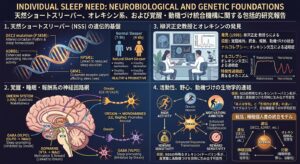
The striking individual variation in how much sleep a person needs — and especially the physiology behind "natural short sleepers," people who maintain high daytime function on remarkably little sleep without any harm to their health — remains one of the central open questions in sleep medicine and neuroscience. This piece works through the pathophysiology of hypersomnia, the discovery history and biology of the orexin system, the genetic and neuroscientific profile of natural short sleepers, how the brain's wakefulness and motivation circuits are integrated, and how to distinguish a genuinely high-arousal constitution from psychiatric conditions that can look similar — all grounded in peer-reviewed primary literature.
Hypersomnia: Definition and Pathophysiology
Hypersomnia describes a group of central nervous system disorders in which severe, uncontrollable daytime sleepiness occurs despite adequate nighttime sleep, or in which nighttime sleep itself becomes pathologically prolonged. It is medically distinct both from simply needing more sleep by constitution (physiological long sleep) and from ordinary excessive sleepiness caused by sleep deprivation.
Narcolepsy type 1 (NT1) results from the autoimmune-mediated, highly specific loss of orexin (hypocretin)-producing neurons in the lateral hypothalamus (roughly 80–100% depletion), and is marked by intense daytime sleepiness alongside cataplexy — sudden loss of muscle tone triggered by strong emotion. Narcolepsy type 2 (NT2) lacks cataplexy, and cerebrospinal orexin levels remain within the normal range. Idiopathic hypersomnia (IH) involves no drop in orexin levels, yet even after 10–12 or more hours of nighttime sleep, patients wake into a severe state of sleep drunkenness.
| Category | Required sleep | Cataplexy | Sleep drunkenness | CSF orexin-A |
|---|---|---|---|---|
| Narcolepsy type 1 | Normal to fragmented | Present | Rare | Markedly low (≤110 pg/mL) |
| Narcolepsy type 2 | Normal to slightly prolonged | Absent | Rare | Normal (>110 pg/mL) |
| Idiopathic hypersomnia | Markedly prolonged (10–12h+) | Absent | Pronounced | Normal |
| Physiological long sleeper | Long (9–10h+) | Absent | Absent (when sleep is adequate) | Normal |
The essential difference between a long sleeper and a hypersomnia patient lies in sleep quality and how normally the person functions during the day. A long sleeper, once their sleep need is met, functions with entirely normal daytime alertness. A hypersomnia patient, by contrast, remains sleepy no matter how much sleep they get.
Masashi Yanagisawa and the Discovery of Orexin
In 1998, a team led by Masashi Yanagisawa and Takeshi Sakurai at UT Southwestern Medical Center ran a systematic screen for endogenous ligands binding to orphan G-protein-coupled receptors of unknown function. They isolated a novel neuropeptide, specifically expressed in the hypothalamus, from rat brain extract; when administered intracerebroventricularly, it strongly stimulated feeding behavior, leading them to name it "orexin" after the Greek word for appetite, orexis (Emmanuel Mignot's team at Stanford independently discovered the same molecule around the same time and named it "hypocretin").
Using reverse genetics, Yanagisawa's team generated mice lacking the prepro-orexin gene, and observed something striking: during the dark phase (the mice's active period), these mice would suddenly go limp and stop moving — a pattern that matched cataplexy and sleep attacks in human narcolepsy almost exactly. Around the same time, Mignot's group pinned down the gene behind hereditary canine narcolepsy: a mutation in the orexin type-2 receptor (OX2R), cementing orexin signaling dysfunction as the primary cause of narcolepsy.
A claim circulates in the media that Yanagisawa himself suffered from hypersomnia, and discovered orexin while researching a cure for his own condition — this is simply false. In primary sources and direct interviews, Yanagisawa has explicitly denied ever having hypersomnia, describing himself as "a completely standard sleeper, getting 7 to 8 hours a night." The discovery of orexin instead traces back to his earlier success discovering endothelin, a cardiovascular signaling peptide; he applied the same orphan-GPCR drug-discovery approach to the brain as a matter of basic biochemical inquiry, not personal illness.
Orexin-producing neurons are localized to the lateral hypothalamus and project broadly to the brainstem's monoaminergic arousal centers — noradrenergic neurons in the locus coeruleus, histaminergic neurons in the tuberomammillary nucleus, serotonergic neurons in the raphe nuclei — as well as to dopaminergic neurons in the ventral tegmental area. Sleep and wakefulness are governed by a "flip-flop switch" in which GABAergic inhibitory circuits in the ventrolateral preoptic area and the brain's arousal systems mutually suppress one another; orexin acts as the stabilizer that prevents this switch from flickering unstably between states. Beyond simply maintaining wakefulness, orexin functions as a broader integrative system spanning the reward pathway (amplifying dopamine release from the VTA and driving goal-directed behavior), appetite and energy metabolism, and stress response and autonomic regulation.
Defining the Natural Short Sleeper
A natural short sleeper (NSS), or familial natural short sleeper (FNSS), is defined in sleep medicine as someone who, without any external constraint like an alarm clock, consistently sleeps only 4–6 hours a night across their entire life while maintaining fully normal daytime alertness, cognitive function, and physical and mental health. Where the typical adult needs 7–9 hours of sleep, FNSS individuals sit at the extreme left tail of that distribution. Far from showing the elevated cardiovascular risk, metabolic dysfunction, immune impairment, cognitive decline, and Alzheimer's-like amyloid-beta accumulation seen in the chronically sleep-deprived, certain FNSS mutation carriers actually show resistance to neurodegeneration and even extended lifespan in model systems.
The clearest marker is whether "catch-up sleep" happens on days off. Chronically sleep-deprived people sleep 1–3 hours longer, or more, when given the chance. A true FNSS wakes naturally at the same short duration regardless of whether it's a weekday or a day off. On daytime attention tasks (the psychomotor vigilance task), sleep-deprived people show frequent lapses and slowed reactions, while FNSS individuals maintain remarkably sharp focus and stable reaction times. Genomic estimates put the true prevalence of genetically confirmed FNSS at well under 0.1% of the population — somewhere between 1 in 10,000 and 1 in 100,000 — making it exceptionally rare. Most people who self-identify as short sleepers are, in reality, chronically sleep-deprived people whose subjective awareness of the deficit has simply gone numb.
The Genes That Govern Sleep Need
Pedigree research by Ying-Hui Fu and Louis Ptáček at UC San Francisco has identified the rare genetic variants underlying familial natural short sleep.
| Gene | Reported | Normal function | Effect of the variant | Average sleep |
|---|---|---|---|---|
| DEC2 (BHLHE41) | 2009 | Transcriptional repressor (clock gene) | Releases repression of the orexin promoter (increased expression) | ~6.25 hrs |
| ADRB1 | 2019 | β1-adrenergic receptor | Strengthens noradrenergic arousal circuitry in the dorsal pons | ~5.7 hrs |
| NPSR1 | 2019 | Neuropeptide S receptor | Gain-of-function; heightens arousal and anxiolytic signaling | ~5.5 hrs |
| GRM1 | 2021 | Metabotropic glutamate receptor 1 | Alters synaptic homeostasis and glutamate signaling | ~5.0 hrs |
The DEC2 point mutation (P384R, a proline-to-arginine substitution at residue 384) alters the protein's ability to repress CLOCK/BMAL1-driven transcription, releasing repression of the orexin precursor promoter and increasing orexin expression. Knock-in mice and fruit flies engineered with these human-derived mutations all show significantly shortened sleep with no measurable loss of memory or learning ability — suggesting these variants don't simply force wakefulness, but make the brain's repair and memory-consolidation processes during sleep genuinely more efficient.
GWAS and twin studies estimate the heritability of sleep duration in the general population at roughly 20–40%. Large-scale genomic analyses using resources like the UK Biobank (Kurien et al., 2022) found that when these single-gene variants turn up incidentally in the general population, sporadic carriers don't necessarily show a strong short-sleep phenotype — penetrance is incomplete. Sleep duration in the general population is a polygenic trait, shaped by the cumulative effect of hundreds or thousands of common variants each with a tiny individual effect; the extreme phenotype seen in FNSS families arises when a highly penetrant rare variant is layered on top of that polygenic background.
Testing the Limits of "Extreme" Short Sleep
The longest sleep duration ever objectively measured in a sleep lab and scientifically confirmed as compatible with genuine long-term health is, at most, 4–6 hours. No clinically documented case exists of a person maintaining good health long-term on just a few minutes to under two hours of sleep a day.
Subjects who have their sleep chronically restricted typically start to feel, after a few days, that they've "gotten used to" the shorter sleep and are "fine." But objective measures — task accuracy, reaction time, short-term memory, tracked via tools like the PVT — keep getting steadily worse, day after day. As prefrontal function declines, the very capacity to accurately judge one's own impairment goes numb along with it, which is exactly what allows the mistaken belief "I'm fine without sleep" to take hold.
Even during periods when a person insists they were awake and active, EEG recordings frequently show "microsleeps" — brief, localized shutdowns lasting a few seconds to tens of minutes. High-density EEG studies have also documented "local sleep," in which the brain overall shows waking-state activity while specific regions — the frontal cortex or thalamus, for instance — locally display slow-wave patterns typical of NREM sleep. The person believes, the entire time, that they are fully awake, while different parts of their brain quietly take turns shutting down. The reverse phenomenon exists too: someone insisting they "barely slept a few minutes all night" while polysomnography records six or seven hours of perfectly normal slow-wave sleep — a condition known as sleep state misperception, or paradoxical insomnia. Reliably distinguishing a genuinely low-sleep-need individual from someone who is simply sleep-deprived without realizing it requires a combined protocol: high-density overnight polysomnography, actigraphy with continuous temperature monitoring, a sustained 24–48 hour PVT under continuous wakefulness, and fMRI assessment of prefrontal cortical load.
The Neural Circuitry of Sleep and Wake
Sleep and wake regulation is governed by the interaction of circadian rhythm (Process C) and sleep homeostasis (Process S), as formalized in Borbély's two-process model. Process C is the roughly 24-hour oscillation driven by the body clock in the suprachiasmatic nucleus. Process S is the process by which sleep-inducing substances such as adenosine accumulate in the brain in proportion to time spent awake, gradually building sleep pressure.
The transition between wakefulness and sleep is orchestrated by several neurotransmitter systems working in concert: orexin (stabilizing the arousal state), dopamine (maintaining alertness and reward prediction), noradrenaline (sustaining attention and high arousal in emergencies), histamine (broad cortical arousal), serotonin (calm wakefulness), acetylcholine (driving both wakefulness and REM sleep), and GABA (directly suppressing arousal centers to initiate sleep).
① Why sleep becomes necessary: excessive strengthening of synaptic connections during waking hours, plus adenosine accumulation. ② How sleepiness is actually felt: adenosine binding to A1/A2A receptors activates the VLPO, and the prefrontal cortex registers that signal (caffeine blocks these adenosine receptors, so sleep pressure itself keeps building while only the felt sensation of sleepiness is masked). ③ What keeps you awake: orexin, noradrenaline, and dopamine override VLPO inhibition and keep sending arousal signals to the cortex. These are three genuinely distinct mechanisms.
Sleep, Ambition, and Motivation
Carriers of genetic FNSS variants aren't just short sleepers — they also tend to show a distinct behavioral and psychological profile: high energy, optimism, strong drive and task-orientation, and unusual resilience to stress.
The best-supported interpretation isn't that short sleep itself creates ambition — it's that "a genetic variant strengthening particular adrenergic, orexinergic, and dopaminergic circuits simultaneously boosts both the capacity to sustain wakefulness and reward-seeking, motivation-driven behavior" — a case of genetic pleiotropy. Orexin neurons connect directly to dopaminergic neurons in the VTA, so strengthened orexin signaling maintains wakefulness while simultaneously amplifying novelty-seeking and goal-directed motivation.
Large-scale GWAS and psychometric studies of the general population find no strong correlation between short sleep duration and extraversion, conscientiousness, or achievement motivation. When someone without a genetic FNSS variant simply cuts their own sleep, the result is impaired prefrontal function, reward-circuit dysfunction, excess impulsivity, and reduced motivation — apathy, not ambition. The claim that "cutting sleep makes you more ambitious" is clearly false as a causal statement. The positive correlation seen within the narrow cohort of genuine FNSS carriers (under 0.1% of the population) reflects a shared molecular mechanism independently producing both traits — pleiotropy, not direct causation. There's also a selection effect at work: successful people tend to underreport how much they actually sleep, in order to emphasize their own effort and ability, which further inflates the "short sleeper equals go-getter" stereotype.
Distinguishing High Arousal From Psychiatric Conditions
The clinical presentation of "doesn't need to sleep and seems fine" does not automatically indicate a healthy natural short sleeper. It has to be distinguished from psychiatric illness, chronic stress, and substance-induced hyperarousal.
| Measure | FNSS | Mania / hypomania | ADHD |
|---|---|---|---|
| Sleep need | Stable, short, lifelong | "Decreased" (episodic) | Difficulty falling asleep, delayed rhythm |
| Mood stability | Very stable, high resilience | Elated, irritable, volatile | Difficulty regulating emotion |
| Thought / cognition | Clear, highly focused | Racing thoughts, poor judgment | Distractible, executive dysfunction |
| Daytime exhaustion | None (genuinely healthy) | None (crashes into depression later) | Present (marked daytime sleepiness) |
A manic episode produces a "decreased need for sleep" — the patient insists they don't need sleep and keeps going — but it comes bundled with racing thoughts, grandiosity, and impulsive risk-taking, and resolves into a severe depressive or hypersomnic crash once the episode ends. This episodic, cyclical pattern is fundamentally different from the lifelong consistency of true FNSS. States where the HPA axis is chronically overdriven by stress, keeping cortisol persistently elevated, or where caffeine or stimulants are being used, are only temporarily masking the brain's underlying fatigue and sleep pressure — and carry real long-term cardiovascular and immune costs.
Studying Family and Genetic Background
When multiple short sleepers appear within a single family, three approaches are used to work out the underlying genetics. Pedigree studies are well-suited to tracing short sleep that follows a dominant inheritance pattern within a family, and have successfully identified rare single-gene variants like DEC2, ADRB1, NPSR1, and GRM1. Twin studies compare sleep patterns between identical and fraternal twins to separate genetic from environmental contribution (heritability of sleep duration, sleep architecture, and chronotype is estimated at 20–40%). Genome-wide association studies (GWAS) search large populations for common variants linked to sleep duration — but each individual common variant identified this way has an extremely small effect, on the order of seconds to minutes.
Sleep need in the general population is shaped by the small combined effect of hundreds of genes — a polygenic trait. The "natural short sleeper who's fine on four hours" seen in particular families is best understood as an exceptional biological phenotype driven by rare, highly penetrant Mendelian variants layered on top of that ordinary polygenic background.
Separating Science From Spiritual Interpretation
Across human societies, unusual sleep patterns and dream experiences have long been bound up with religious and spiritual thinking. Scientific fact and mystical interpretation need to be kept clearly apart. In spiritual discourse, short sleepers and insomniacs are sometimes framed as having "a higher soul vibration," having "ascended to a new dimension," or "drawing on universal energy (prana) instead of needing rest" — with an even more extreme version of this claim appearing as "breatharianism," the notion that a person can live without food or sleep at all. Long sleepers, in the same discourse, are sometimes said to be "processing karmic purification," and lucid dreaming is framed as "astral projection or access to a parallel world."
No human being can sustain life while genuinely forgoing both food and sleep entirely. Every person who has claimed to do so, when placed under rigorous scientific observation — continuous biometric monitoring in a sealed research setting — has, without exception, either been caught secretly eating or sleeping, or has had the experiment terminated by acute dehydration or organ failure. Sustaining life without rest or caloric intake is flatly incompatible with the first law of thermodynamics and basic cellular metabolic physiology. The difference between a short sleeper and a long sleeper has nothing to do with spiritual rank or the "level" of one's soul — it is a physiological phenomenon rooted in molecular-level differences in transcriptional and signaling efficiency across orexin receptors, adrenergic receptors, and clock genes. Dreams, too, are simply a product of cholinergic activation in the cortex during REM sleep, combined with memory consolidation and emotional processing in the hippocampus and amygdala — a physical property of neural circuitry, nothing more.
Key Primary Literature, Summarized
| Paper | Lead author / year | Key finding |
|---|---|---|
| The transcriptional repressor DEC2 regulates sleep length in mammals | Ying-Hui Fu, 2009, Science | Identified DEC2 (P384R) as the first known FNSS-causing gene; demonstrated in transgenic mice that the mutation releases repression of the orexin promoter, shortening sleep |
| A Mutation in ADRB1 Causes a Natural Short Sleep Phenotype in Humans | Guangsen Shi, 2019, Neuron | Found that the A187V mutation in the β1-adrenergic receptor gene causes FNSS; mapped the mechanism strengthening noradrenergic arousal circuitry in the dorsal pons |
| Mutations in NPSR1 cause a natural short sleep phenotype in humans | Subhabrata Xing, 2019, Sci Transl Med | Identified the gain-of-function P206L mutation in NPSR1 as a cause of short sleep; reported a protective effect against amyloid-beta accumulation |
| Mutations in metabotropic glutamate receptor 1 contribute to natural short sleep in humans | P. Kurien, 2021, Curr Biol | Found that mutations in GRM1 cause FNSS; proposed a mechanism involving excitatory transmission and synaptic sleep homeostasis |
| Evaluating the population penetrance of reported Mendelian sleep variants | P. Kurien, 2022, PLOS Genetics | Analyzed penetrance of reported FNSS variants in a ~190,000-person UK Biobank cohort; highlighted the importance of polygenic background |
| Narcolepsy in orexin knockout mice | R. M. Chemelli, 1999, Cell | Discovered that prepro-orexin knockout mice display cataplexy-like behavior resembling human narcolepsy |
| Cumulative sleep deficits, neurobehavioral performance, and sleepiness | H. P. Van Dongen, 2003, Sleep | Demonstrated that under chronic sleep restriction, subjective sleepiness plateaus while objective cognitive performance keeps declining linearly |
Overall Assessment and Open Questions
Individual variation in sleep need comes down to how efficiently a person's genome — through a combination of polygenic background and rare variants — sets up both "the processing efficiency of sleep homeostasis" (synaptic repair, metabolic clearance) and "the driving force behind the wakefulness-maintenance system." Someone with an efficient repair mechanism can complete the brain's overnight reset in a shorter stretch of slow-wave sleep.
Rather than a direct causal claim — "short sleep produces ambition" — the evidence points to a shared genetic basis: the same neural circuitry, particularly the orexin, monoamine, and dopamine systems, simultaneously drives both sustained wakefulness and goal-directed motivation, a case of pleiotropy. This biological basis, however, is confined to genuinely confirmed FNSS carriers — under 0.1% of the population; when an ordinary person forces their own sleep shorter, the opposite happens, and both drive and cognitive function deteriorate. Orexin functions as a master regulator, projecting from the hypothalamus to the dopaminergic VTA and unifying wakefulness, feeding, metabolism, sympathetic tone, and reward-driven motivation into a single integrated system — serving as the central bridge that lets high arousal and high motivation be sustained together.
- Specific loss of orexinergic neurons is the direct cause of narcolepsy type 1.
- Single-gene variants in DEC2, ADRB1, NPSR1, and GRM1 produce a natural short sleeper phenotype without harming health.
- Masashi Yanagisawa did not have hypersomnia; the discovery of orexin was a product of basic biochemical screening.
- Even when it subjectively feels "fine," sleep deprivation causes a linear decline in prefrontal function and objective cognitive performance in the general population.
- The detailed molecular circuitry by which FNSS variants may protect against neurodegenerative disease and aging processes.
- Whether orexin receptor agonists could someday artificially control wakefulness, cognition, and motivation beyond treating hypersomnia.
- The full picture of the polygenic risk score underlying ordinary individual variation in sleep need.
- The claim that a person can live healthily long-term on just a few minutes to under two hours of sleep a day.
- The claim that forcibly cutting sleep makes a person more ambitious or more likely to succeed at work.
- The claim that most short sleepers in the general population carry a single "short sleeper gene."
In closing
Natural short sleepers really do exist — but they are an extraordinarily rare genetic exception, affecting well under 0.1% of the population. For nearly everyone else, cutting sleep is not a source of ambition; it quietly erodes the brain's own performance instead. Sleep isn't slacking off. It might be better understood as the quiet, essential work your brain does each night to rebuild tomorrow's version of you.
( _ _)..zzzZZ good night